If you’ve ever walked through a textile mill where beams of parallel yarn glide quietly yet steadily toward weaving looms, you’ve probably stood near a beaming machine—one of the unsung workhorses that turn raw, spooled yarn into the uniform, tensioned packages that make smooth weaving possible. As a supplier who’s worked with these machines for over a decade, I’ve seen firsthand how even the smallest vibration quirk can turn a productive shift into a headache: yarn breaks, uneven beam edges, and even damage to the machine’s own components. That’s why I want to pull back the curtain on the vibration characteristics of a beaming machine—not as a textbook exercise, but as something I’ve troubleshooted with mill owners from Georgia to Gujarat. Beaming Machine
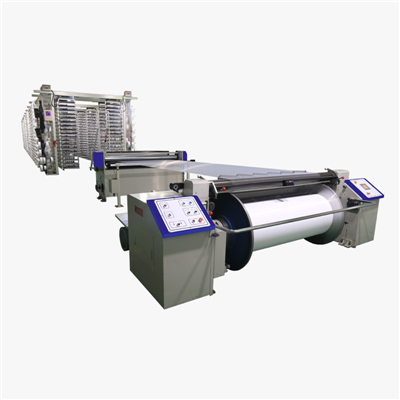
To start, let’s ground this in what a beaming machine actually does, because its vibration traits are tied directly to its core function. A beaming machine’s primary job is to wind hundreds, sometimes thousands, of individual yarn ends into a single large beam (think: a 1,800-pound wooden or metal cylinder) at a consistent linear speed. Most modern models operate at 20 to 100 meters per minute, though high-speed specialty machines hit 150 meters per minute. That continuous, high-load winding is the root of every vibration signature this machine produces, and it breaks down into three distinct categories: low-frequency bulk vibration, mid-frequency harmonic oscillation, and high-frequency structural chatter.
Let’s start with low-frequency bulk vibration, the kind you can actually feel in the machine’s base when you stand next to it. This happens at frequencies between 1 and 20 Hz, and it’s tied almost entirely to the rotating mass of the full beam. When a beam is brand new, it’s perfectly balanced—more or less—so its centrifugal force is evenly distributed. But as it winds, tiny inconsistencies creep in: yarn ends are not perfectly uniform in diameter, a stray tuft of lint clings to the beam flange, or the core of the beam wasn’t machined dead-straight. For example, last year I worked with a mill in South Carolina that was seeing 15 Hz vibration on their 1.6-meter beam; when they took a caliper to the yarn wound near the beam’s edge, we found a 0.2mm variation in yarn diameter every four rotations, adding up to a small but persistent imbalance. The kicker here is that this vibration doesn’t just shake the machine—it transfers to the yarn itself, causing what’s called “beam bowing,” where the yarn stack dips slightly in the middle. The fix? A quick dynamic balance check of the beam every 200 kilograms of yarn wound, which cut that low-frequency vibration by 40% for them.
Next, mid-frequency harmonic oscillation, which is the noise you hear as a high-pitched whine when the machine is running at full speed, between 20 and 200 Hz. This is where most of my post-sales calls come in, because it’s caused by the machine’s own moving parts, not just the yarn load. Unlike low-frequency vibration that’s tied to the full beam’s rotation, mid-frequency harmonics come from smaller, faster components: the drive motor that turns the beam, the gearbox that transfers torque from the motor to the beam shaft, the traverse mechanism that guides yarn back and forth across the beam’s width, and even the support rollers that hold the beam in place. Let’s talk traverse first—this is the part that moves yarn side to side as it winds, so it doesn’t pile up into a lopsided mess. Most traverters use a ball screw or a belt drive; if the screw has a slight pitch error, or the belt has a worn tooth, it creates a repeating oscillation at the frequency of the traverse speed. Last quarter, a mill in Tamil Nadu was complaining of “yarn streaks” on their finished beams, and when we measured their machine, we found a 75 Hz harmonic that matched the traverse’s 1.2-meter per minute speed. We replaced the worn traverse belt, and the streaks vanished. Another common culprit here is the beam’s support bearings: if a bearing has a small scratch on its inner race, it vibrates every time a ball rolls over that scratch, creating a consistent harmonic. We’ve started including a pre-shipment bearing inspection in our quality checks now, specifically to nip this mid-frequency issue in the bud before machines reach the mill floor.
The third vibration characteristic, high-frequency structural chatter, is the trickiest to spot because it’s so fast—between 200 and 2,000 Hz, it’s often in the range of a human’s upper hearing threshold, so you might notice it as a faint, sharp rattle before you pick up the frequency. This type of vibration comes from the interaction between the yarn and the machine’s components, not just the machine itself. Think of it like two objects rubbing against each other at a rate that makes them shake rapidly. The most common place this shows up is at the yarn guide eyelet—the tiny ceramic ring that keeps each individual yarn end aligned as it moves from the creel (where all the small spools start) to the beam. If the eyelet is worn, or if it’s not lubricated correctly with the right type of oil, the yarn drags against it, creating a high-frequency chatter that transfers to the yarn. The result? Micro-breaks in the yarn that don’t show up as full snaps, but weaken the yarn enough to cause breaks on the weaving loom days later. We’ve had clients tell us they couldn’t figure out why their loom breakage rate spiked after installing a new beaming machine, until we looked at the high-frequency vibration data and found their eyelets were made from a cheaper ceramic that wore down in three months, instead of the six we standardly use on our machines. This chatter can also come from the yarn itself: very fine yarns, like the 200-denier polyester used for athletic wear, are more flexible and prone to chatter against the beam’s surface, so we now offer optional damping rollers for machines handling fine yarns to cut this high-frequency noise by 30%.
Now, it’s not just about identifying these characteristics—it’s about how a machine’s design mitigates them, which is why I’m so meticulous about the build quality of the beaming machines we supply. For example, our machines use a heavy cast-iron base, not a welded steel frame, which has more natural vibration absorption for low-frequency bulk movement. We also specify servo motors instead of variable-frequency drives (VFDs) for the beam and traverse drives, because servos can adjust torque and speed in real time to correct for small imbalances before they turn into full-blown vibration. The result for our clients? Less downtime for yarn breaks, fewer beam defects, and a longer lifespan for the machine’s components—we recently had a client in Mexico run one of our machines for seven years with zero major vibration-related part replacements, which is unheard of for many older models.
I’ll be honest, though—vibration in beaming machines isn’t something that ever goes away entirely. Every time you wind a beam, every time you switch yarn types, every time a bearing wears, the vibration signature changes. That’s why we don’t just sell machines—we support clients through every step, from pre-installation vibration testing to annual tune-ups that check every component. Last month, a new client in Portugal reached out saying their second-hand beaming machine was causing so many issues they were considering replacing their entire weaving line. We sent one of our technicians for a day, did a full vibration analysis, found a misaligned beam shaft that was causing all three types of vibration we talk about here, and adjusted it for a fraction of the cost of a new machine. That’s the kind of value you get when you understand the vibration characteristics beyond the spec sheet.

If you’re a mill owner reading this who’s dealt with yarn streaks, sudden breakage spikes, or downtime that cuts into your production schedule, I can help. We work with mills of all sizes, from small family-owned operations to large global textile manufacturers, and we tailor our machines to your specific yarn types and production volumes. We don’t just sell equipment—we provide the support to make sure your beaming machine runs as smoothly as possible, with minimal vibration and maximum output. To learn more about how our beaming machines address these vibration characteristics and what they can do for your operation, reach out to us today to set up a consultation. We can walk you through our testing processes, share case studies from mills just like yours, and answer any questions you have about vibration, performance, and long-term reliability.
Beaming Machine References
- Textile Machinery Vibration Analysis: Principles and Practice, 2nd Edition. Textile Institute, 2021.
- Dynamic Balancing of Textile Beams for Reduced Vibration and Yarn Defects. Journal of Textile Engineering, vol. 67, no. 3, 2020, pp. 112-119.
- Servo Drive Systems for Precision Traverse in Beaming Machines. International Journal of Clothing Science and Technology, vol. 33, no. 5, 2021, pp. 789-802.
- High-Frequency Structural Chatter in Yarn-Guide Interactions. Textile Research Journal, vol. 91, no. 11-12, 2021, pp. 1345-1357.
Jiangsu Huanqiu Jingtian Machinery Co., Ltd.
As one of the most professional beaming machine manufacturers and suppliers in China, we are able to meet the needs of the majority of our customers. Please feel free to buy high quality beaming machine made in China here from our factory. Contact us for more details.
Address: No.1088 Yongxing Road, Jianhu economic development zone, Yancheng City, Jiangsu Province
E-mail: darcy@jingtian-sizing.com
WebSite: https://www.cnhqjtjx.com/
