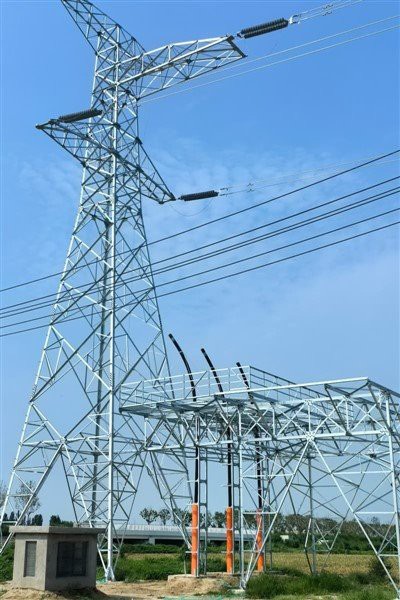
When you drive along a highway or stand in a rural field, you’ve probably glanced up at the tall metal towers holding power lines high above the ground. For most people, these towers are just part of the landscape—something to ignore while you travel or work. But for the team at [Your Company Name], an overhead line tower supplier we’re constantly asked one question that doesn’t get enough simple, clear answers: how far apart are overhead line towers placed? This isn’t a random number we pull out of thin air. It’s a calculation that blends engineering needs, environmental factors, and the real-world challenges of moving power from a plant to your home. Overhead Line Tower

Let’s start with the basics: why does spacing matter in the first place? Each tower supports a set of power lines, usually three or more for high-voltage transmission. If two towers are too far apart, the lines between them will droop—engineers call this “sag”—too much. In hot weather, metal lines expand, so that sag gets even worse. If sag is excessive, the lines might dip low enough to hit the ground, vegetation, or even buildings, which is a major safety risk. On the flip side, if towers are too close together, you’re wasting money. Each tower is an expensive piece of equipment: not just the steel itself, but transport to the site, foundation work, and installation labor. For a long transmission line stretching hundreds of miles, cutting spacing by even a small amount can add thousands of towers to the project, blowing the budget out of proportion.
That balance between sag risk and cost is the first big driver of tower spacing. But it’s not the only one. Different types of power lines need different spacing. Distribution lines, which carry lower-voltage power to neighborhoods, usually have smaller, lighter lines. Their towers can be spaced closer together—sometimes as little as 100 feet apart in urban areas, where space is tight and towers can’t be too tall. But transmission lines, which move high-voltage power across long distances, use much heavier, thicker lines. Those need wider spacing to account for the bigger sag. For standard 230 kV transmission lines, the most common for regional power movement, spacing usually falls between 500 and 1,000 feet. For higher 500 kV lines, which carry power across states or even longer distances, spacing can jump to 1,000 to 1,500 feet. That’s a huge range, and it all depends on the specifics of the line.
Now, let’s get into the factors that tweak that number further, because there’s no one-size-fits-all answer. First, climate is a huge one. If a line runs through a place with extreme temperature swings—like the American Midwest, where summer heat can hit 100°F and winter cold can drop below zero—engineers have to calculate sag for both extremes. In warmer areas like the Gulf Coast, where heat is consistent year-round, they might not have to account for as much expansion, so spacing can be a bit wider. But places with heavy snow or ice add another layer: ice adds weight to the lines, pulling them down more. That means towers have to be closer together to prevent the lines from touching the ground under the weight of a winter storm. We’ve worked on projects in northern states where ice storms forced us to adjust spacing by 200 feet to keep lines safe, even though the initial design had wider gaps.
Terrain is another big factor. Flat, open land like the Great Plains is ideal for wider spacing. There’s no obstacles, so towers can be set far apart without worrying about lines dipping into trees or buildings. But in mountainous areas, spacing gets tighter. Mountain slopes mean the ground between towers isn’t flat, so the sag has to account for uneven elevation. Plus, mountain winds are much stronger than on flat land. High winds can push lines to the side, so you need closer towers to keep the lines from swinging too far and hitting each other or nearby terrain. We had a project in the Rocky Mountains a few years back where the final spacing was 800 feet, even though the initial design called for 1,200 feet—because the steep slopes and gusty winds made the wider spacing too risky. Urban areas are the opposite: space is limited, so towers are closer, but you also have to consider the height of nearby buildings. Lines have to stay far enough above rooftops to avoid safety hazards, so sometimes you’ll see taller towers in cities that allow slightly wider spacing than you’d expect, just to clear buildings.
Vegetation also plays a role, especially in rural areas. If a line runs through a forest, the lines have to stay above the tallest trees. If trees grow tall, the initial design might require closer spacing to keep sag from hitting tree tops. In areas with fast-growing trees, sometimes engineers even adjust spacing over time, adding a few extra towers if vegetation grows faster than expected. We once supplied towers for a project in the Pacific Northwest where Douglas firs were growing at a rate of 2 feet a year, so the final spacing was 600 feet instead of 900 feet to account for future tree growth.
But here’s something a lot of people don’t realize: tower spacing isn’t just about the lines between them. The towers themselves have to be strong enough to handle the distance between them. A tower set 1,500 feet apart has to be taller and sturdier than one set 500 feet apart, because it’s supporting more line weight over a longer span. That’s where our team at [Your Company Name] comes in. We don’t just build towers—we work with project engineers to design towers that match the required spacing, so they’re strong enough for the span but not overbuilt, which would add unnecessary cost.
Let’s also clear up a common myth: spacing isn’t related to tower height. A taller tower doesn’t automatically mean wider spacing, and a shorter tower doesn’t mean closer. Tower height depends on how high the lines need to be above the ground, terrain, and obstacles. A tall tower in a flat field might hold lines 100 feet above the ground, but if the span between two such towers is 1,200 feet, that’s determined by sag and line weight, not height. A shorter tower in a city might hold lines 50 feet above a rooftop, but if the span is 800 feet, that’s again based on the line and terrain, not height.
Another factor is regulatory requirements. Local and national power authorities have strict rules for how high lines must be above ground, roads, and water, and those rules can change based on voltage. For example, in the U.S., the National Electrical Safety Code (NESC) sets minimum clearance distances for power lines. If a line runs over a highway, it needs to be at least 18 feet above the road for lower voltage lines, and up to 50 feet for high-voltage transmission lines. That clearance affects how much sag is allowed, which in turn affects spacing. If a line is crossing a highway, engineers have to calculate the sag so it doesn’t dip below that minimum clearance, which might mean closer towers to keep the lines high enough.
We’ve seen how these factors come together in real projects over the years. A recent project we worked on in Texas, a 500 kV transmission line running through the Hill Country, had an initial proposed spacing of 1,400 feet. But after a site survey, engineers found the terrain was rolling, with lots of oak trees, and summer temperatures regularly hit 105°F. That meant the lines would sag more in the heat, and the oak trees would grow tall enough to hit the lines if spacing was that wide. We adjusted the tower design to a slightly stronger, taller tower, and the final spacing was set to 1,100 feet. It was a small change, but it was the difference between a project that was safe and compliant, and one that would have needed costly tree trimming or line repairs down the line.
For smaller projects, like distribution lines for a new housing development, spacing is much tighter. We often supply towers spaced 200 to 300 feet apart for these lines, which carry 10 kV to 35 kV power. These lines aren’t as heavy as transmission lines, so they can handle smaller spans, and in a neighborhood, you don’t want towers too far apart because they’d be taller and more obtrusive. Homeowners don’t want a 100-foot tower in their backyard, so shorter, closer towers are the better choice, even if it means more of them.
You might also wonder about maintenance. Wider spacing can make maintenance harder. If a line is down between two towers 1,500 feet apart, a crew has to work harder to access the middle, but if towers are 500 feet apart, a crew can work from one or the other without needing extra equipment. That’s a tradeoff project teams have to make: wider spacing saves on tower cost, but might add to maintenance costs over the life of the line. Our team always factors that into our consultations, helping clients find the sweet spot between upfront cost and long-term upkeep.
So what does this mean for someone looking to install a new overhead line? The short answer is there’s no universal number, but a good rule of thumb is: distribution lines (low voltage) are 100 to 500 feet apart, regional transmission (230 kV) are 500 to 1,200 feet, and long-distance transmission (500 kV and up) are 1,000 to 1,800 feet. But that’s just a starting point. Every project is unique, and that’s where expertise matters.
At [Your Company Name], we’ve been in the overhead line tower industry for years, working with engineers, utility companies, and construction teams to design and supply towers that fit every project’s needs. We don’t just sell a standard tower—we collaborate with clients to assess terrain, climate, voltage, and regulatory requirements to find the right spacing and tower design. Whether you’re building a distribution line for a new subdivision, a regional transmission line, or a long-distance power corridor, we can help you avoid the common mistakes that come with guessing tower spacing, like overspending on too many towers or risking safety with too few.
If you’re planning an overhead line project and need to get the tower spacing right, or just have questions about tower design and supply, our team is here to help. We’ve worked on projects across the country, from urban distribution lines to mountain transmission corridors, and we have the experience to guide you through every step. Don’t let guesswork lead to costly delays or safety issues—reach out to our team to discuss your project and get the customized tower solutions you need.
Monitoring Tower References
- National Electrical Safety Code (NESC), 2023 Edition, Institute of Electrical and Electronics Engineers.
- Overhead Transmission Line Design Guidelines, North American Electric Reliability Corporation (NERC), 2021.
- "Factors Affecting Overhead Line Tower Spacing," Journal of Power Engineering, Vol. 45, No. 2, 2022, pp. 89-104.
- "Climate and Terrain Impacts on Transmission Line Sag," Electric Power Research Institute (EPRI) Technical Report, 2020.
- Distribution Line Design Manual, International Brotherhood of Electrical Workers (IBEW), 2019.
Hebei Yifeng Steel Structure Co., Ltd.
As one of the most professional overhead line tower manufacturers and suppliers in China, we offer a wide range of products with superior quality. Please feel free to buy cost-efficient overhead line tower for sale here from our factory. Contact us for more details.
Address: Guangchuan Town Industrial Zone, Jing County, Hengshui City, Hebei Province
E-mail: hbyfgjg@163.com
WebSite: https://www.yf-powertowers.com/
