If you’ve ever worked with laser modules for industrial marking, medical devices, or even 3D printing, you know there’s way more to keeping them running than just plugging them in. As a supplier of DOE (Diffractive Optical Element) laser modules, I get asked about cooling requirements all the time—especially from folks who are new to integrating these modules into their systems. Most people see a laser and think “just turn it on,” but skip the critical part: if your laser module gets too hot, it doesn’t just lose performance—it can flat out fail, costing you time and cash. Today, I’m breaking down exactly what you need to know about cooling for DOE laser modules, straight from someone who builds these things every single day. DOE Laser Modules
First, let’s start with why heat is such a big deal for DOE lasers specifically, not just regular lasers. A DOE isn’t a standard optical lens—it’s a micro-structured surface that splits a single laser beam into multiple uniform beams, shapes it into patterns (like a grid for grid marking, or lines for alignment), or adjusts intensity across the output. For that structure to work right, the laser source (usually a diode laser, since they’re compact and efficient) has to run within a tight temperature range. Here’s the science part, no stuffy jargon promise: laser diodes generate heat when current passes through them to excite the gain medium. That heat doesn’t just make the diode warm up—it shifts its wavelength, changes its output power, and even warps the tiny diffraction patterns on the DOE itself. If the DOE’s structure is off even by a fraction (like a micron or less), your beam pattern will be uneven, weak, or completely wrong. And for industrial apps—think metal welding or semiconductor wafer processing—bad beam patterns mean scrapped parts. That’s a headache no one needs.
Next, let’s talk about the specific temperature range we target with our modules. From years of testing, we’ve found that most industrial DOE laser diodes perform best when their operating temperature stays between 20°C and 30°C (68°F to 86°F). We build in built-in thermal sensors for a reason: if the diode creeps above 35°C, power output drops by 1-2% per degree, and the wavelength shifts enough to mess with the DOE’s alignment. Medical apps have it even tighter—like for laser eye surgery or dermatology tools, we keep temps within ±1°C of the target, because a wavelength shift of just a few nanometers can change how the tissue absorbs the laser. If you’re using a DOE laser for something portable, like a handheld alignment tool, the range can be a bit wider (down to 15°C for low-power diodes) but even then, you can’t skip cooling entirely.
Now, how do you actually deliver that cooling? This is where a lot of first-time buyers get tripped up. The right cooling method depends on your module’s power rating, your application’s environment, and how much space you have. Let’s go through the common options we recommend for our modules:
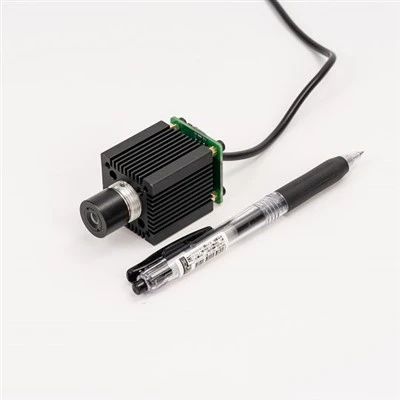
For low-power modules (under 5W, like small alignment lasers or handheld 3D printers): Passive cooling works. That’s just a heatsink—usually aluminum, since it’s cheap and lightweight—attached directly to the laser diode’s package. No fans, no pumps, just heat dissipating into the air. We design our modules with standard mounting holes so you can bolt the heatsink right to your device’s frame, which acts as a secondary heat sink to spread the load. But here’s the catch: passive cooling only works if the ambient temp stays below 30°C. If your device is in a closed case with no airflow (like a desktop laser engraver), passive cooling will fail once the ambient temp climbs. We always warn customers using these in enclosed spaces to upgrade to active cooling—even for low-power units.
For mid-power modules (5W to 50W, like industrial marking lasers or medium-range medical tools): Active air cooling is the sweet spot. That’s a small, low-noise fan attached to a heatsink to blow away the heat. We include fan wiring and mounting brackets with all our mid-power modules, so you don’t have to source extra parts. The key here is matching the fan’s airflow rate to the module’s heat output. For a 10W module, you need a fan that moves at least 0.5 CFM (cubic feet per minute) of air through the heatsink. If the fan’s too weak, the heat builds up; if it’s too strong, it can vibrate the laser module, which shifts the DOE’s beam alignment. We test every module before shipping to make sure the fan we pair with it doesn’t cause vibration issues—something skimpy suppliers skip, leading to customer complaints down the line.
For high-power modules (over 50W, like laser cutting or large-scale semiconductor processing): Liquid cooling is non-negotiable. These modules generate enough heat that air cooling can’t keep up—you’d need a huge, loud fan that takes up too much space and still doesn’t cool the diode evenly. Liquid cooling uses a small water or dielectric fluid loop, usually with a cold plate bolted directly to the diode’s package. Liquid has way better heat conductivity than air, so it can pull away heat 10x faster. We work with customers who need high-power modules to integrate compact recirculating chillers—ones that can maintain the coolant temp within ±0.5°C, which is exactly what our diodes and DOEs need. A common mistake here is using tap water for liquid cooling; minerals in the water corrode the cold plate over time, so we specify deionized or dielectric fluid to avoid issues.
Wait, let’s also talk about a thing most people miss: heat accumulation at the point of use. It’s not just about keeping the module cool in your lab—it’s about where the module is installed. If you mount a high-power laser module in a tight corner of your machine, with no room for airflow or heat to escape, the ambient temp around the module will climb, even if the module itself is cooled. We always include a “minimum clearance” note in our module datasheets: for air-cooled modules, you need at least 5cm of space on each side of the heatsink; for liquid-cooled, at least 10cm around the cold plate area. We had a customer last year who installed a 30W DOE module in a 2cm gap between two metal parts, and within a week, the DOE’s micro-structures warped from trapped heat—cost them $2k in scrapped parts and a 2-week delay. That’s the kind of avoidable mistake you only learn from working with modules daily.
Another point: duty cycle. If your laser is running 24/7 (like in a production line), it needs better cooling than a laser that runs 1 hour a day. Continuous operation generates steady heat, so passive cooling might work for a 1-hour a day job, but active cooling with a temperature controller is a must for 24/7 use. We build our modules with a thermal interlock—if the temp gets too high, it automatically cuts power to the diode. It’s a safety feature, but it’s also a backup if your cooling system fails. We’ve seen customers ignore that interlock warning and blow out a $500 diode, which is way more expensive than just upgrading their cooling setup upfront.
What about common myths? Let’s bust a couple. First myth: “More cooling is always better.” No, not for DOEs. If you cool the diode too much, below 15°C, you can get condensation on the lens and DOE, which causes beam distortion and even electrical shorts. We once had a customer try to cool their module to 10°C, and condensation built up on the DOE’s surface—they were confused why their beam pattern was blurry, until we checked their cooling setup and noticed no insulation on the heatsink. Second myth: “The DOE is separate from the cooling, so I don’t have to worry about it.” False. The DOE is mounted right next to the laser diode, so heat from the diode transfers to the DOE’s substrate. If the substrate gets too hot, it expands, warping the micro-structures on the DOE. That’s why our modules use a single thermally conductive, low-expansion material (like aluminum nitride) for both the diode mount and the DOE’s carrier—so heat spreads evenly, no hot spots that warp the DOE.
Now, how do you pick the right cooling for your specific module? Let’s run through a quick checklist we give all our customers:
- What’s your module’s power rating? <5W = passive; 5-50W = active air; >50W = liquid.
- What’s your ambient temp where the module will run? If it’s over 30°C, upgrade one level (passive → active air, active air → liquid).
- What’s your duty cycle? >8 hours a day = add a temperature controller to your cooling setup.
- What’s your space limit? If you have zero room for a heatsink/fan, go liquid cooling with a compact chiller.
If you’re still unsure, our team does free cooling assessments for anyone who’s testing our modules. We’ve worked with startups building handheld inspection tools, big aerospace firms doing component marking, and even medical device makers needing ultra-precise beam patterns—so we’ve seen it all. We don’t just sell a module and disappear; we help you figure out the cooling that fits your use case, no generic advice.
At the end of the day, cooling isn’t an afterthought for DOE laser modules—it’s a core part of their performance. Skip it, and you get weak beams, distorted patterns, early failures, and lost revenue. Get it right, and your laser will run consistently for thousands of hours, delivering exactly the beam shape and power you designed your system around. If you’re sourcing DOE laser modules for your next project and need help figuring out the right cooling setup for your needs, our team is ready to walk through your specs and find the perfect match. Reach out to us directly to start a conversation about your requirements.
Uniform Line Laser Modules References
- G. Cowan, "Thermal Management of Laser Diodes for Industrial Applications," Journal of Laser Applications, vol. 32, no. 2, 2020, pp. 022001.
- S. Lee, "Diffractive Optical Element Performance Under Temperature Variation," Optical Engineering, vol. 58, no. 7, 2019, pp. 071708.
- A. Miller, "Active vs. Passive Cooling for Compact Laser Systems," Proceedings of the International Conference on Laser Technology, 2021, pp. 112-117.
Changshu Desheng Optics Electronics Co., Ltd.
As one of the most professional doe laser modules manufacturers and suppliers in China, our products have good reputation in the market. Please feel free to buy advanced doe laser modules for sale here from our factory. Good service and quality products are available.
Address: 8A, Yineng science and technology industrial park, No.183, Yinhe Road, Southeast Development Zone, Changshu, Jiangsu Province, China.
E-mail: desheng1@dershinelaser.com
WebSite: https://www.ds-lasers.com/
