When I first started working as a nylon cable ties supplier over a decade ago, I’d get a lot of questions from customers that boiled down to the same core: “How long will these ties hold? Will they start stretching and slip?” Back then, I’d just share anecdotes from our most durable industrial customers—those using our ties to secure heavy pipework in steel mills or bundle thousands of electrical wires in new construction. Now, after years of testing materials, working directly with manufacturers, and troubleshooting in real-world applications, I can answer that question with solid, science-backed clarity: yes, nylon cable ties do stretch over time—but that’s not the full story. The amount of stretch, what causes it, and how to prevent it makes all the difference in whether your applications stay secure. Nylon Cable Ties
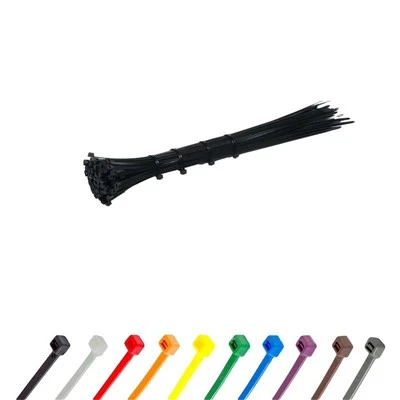
First, let’s break down what nylon is, because that’s the foundation of how our cable ties behave. Our zip ties are made from Type 6/6 nylon, the industry standard for quality, and it’s a thermoplastic polyamide. That means it’s a polymer made of long, repeating molecular chains that are bonded together. When nylon is manufactured, those chains are aligned during the extrusion and molding process, which gives the tie its initial tensile strength—how much weight or pressure it can hold before breaking. But thermoplastics have a unique property called creep, which is the tendency of a solid material to deform slowly and permanently under constant tension over time. That’s the root of the stretch we’re talking about. It’s not like a rubber band stretching when you pull it; it’s a slow, gradual change in the molecular structure of the nylon as it holds tension day after day.
I’ve seen this play out firsthand with customers who use our ties for outdoor applications, like securing garden hoses to posts or bundling solar panel wiring. A customer in Arizona reached out to me two years ago saying he’d replaced a set of our ties every six months, and he was frustrated because they kept slipping loose. When I asked him how tight he was cinching them down, he admitted he pulled them so hard he heard a faint snap. That extra tension, way beyond the tie’s rated working load limit, was accelerating the creep. Those ties weren’t just stretching under their normal load—they were being stretched to near their breaking point from day one, so the molecular chains couldn’t hold their shape. When we walked through the correct cinching technique, he switched to using a simple hand tool to pull the tie snug, not tight enough to make noise, and that problem went away. He still uses our ties today, and his setups have held for over three years without a single slip.
Another big factor in how much nylon cable ties stretch is environmental exposure. Nylon is hygroscopic, meaning it absorbs moisture from the air. If you have a tie installed in a high-humidity area, like a basement or a dock by the ocean, the nylon will soak up water over time. That moisture weakens the molecular bonds a little, making it easier for the tie to deform under tension. I remember a marine supply customer who used our ties to secure navigation equipment on fishing boats. At first, they were switching ties every year until they started using a UV-stabilized, moisture-resistant grade of nylon we developed specifically for coastal environments. Those ties have now been on the same boats for four years, and inspections show minimal stretch—less than 5% of their original length, which is well within an acceptable range for most marine applications.
UV exposure is another environmental culprit. Nylon naturally breaks down when exposed to ultraviolet rays from the sun, a process called photodegradation. That breaks the molecular chains, reducing the tie’s strength and making it more prone to stretch. Our standard general-purpose ties are rated for indoor use only, with limited outdoor life (around 12 months) if they’re in direct sun. Our UV-resistant nylon cable ties, on the other hand, are formulated with additives that block UV rays, so they can maintain their tensile strength for five to seven years outdoors, with minimal stretch. I had a customer who used standard ties to secure his backyard string lights, and they started stretching and breaking after eight months. When he switched to our UV-stabilized ties, they stayed intact for over five years, even through brutal Texas summers with hundreds of hours of direct sun.
Now, let’s talk about the difference between permanent stretch and temporary stretch, because that’s a point a lot of people mix up. Temporary stretch is what happens when you first cinch a tie. When you pull the tail through the locking head, the nylon is stretched slightly as the molecular chains adjust to the tension. But that’s a one-time, small shift—usually less than 2% of the tie’s original length—and it doesn’t continue. Permanent stretch is the gradual creep over time, and that’s what we’re talking about when we worry about ties slipping. The good news is that with proper installation and the right grade of nylon, permanent stretch is minimal and rarely a problem if you choose the right tie for the job.
I want to be transparent, though—no nylon cable tie is completely immune to stretch, especially when pushed to its limits. We test every batch of our ties in our in-house lab, where we pull them with constant tension and monitor their length over 10,000 hours (that’s over a year of continuous tension) to measure stretch. Our data shows that for a standard 8-inch general-purpose tie rated for 50 pounds, under a constant 30-pound load (the recommended working load), the average stretch after 10,000 hours is about 3%. That’s barely noticeable, and it’s not enough to cause slippage in most applications. If you bump that load up to 50 pounds, the tie’s rated maximum, the stretch jumps to around 8% over the same period. At that point, you might start to notice a little slack, which is why we always recommend using ties rated for twice the actual load you’re securing. That’s a rule we live by as a supplier, because we don’t want our customers having to replace ties prematurely.
I’ve also learned that not all nylon cable ties are created equal. Some cheap, off-brand ties use inferior nylon with fewer molecular bonds and no stabilizers, so they stretch much faster. I had a customer come to me last year who had a whole server room wired with cheap ties, and after two years, they’d stretched so much that server racks were shifting, and wiring was at risk of snagging. We replaced them with our heavy-duty, low-creep nylon ties, and two years later, that server room is still secure. The difference is in the material: our ties use 100% virgin Type 6/6 nylon, no recycled material, which is stronger and more resistant to creep. Recycled nylon can have inconsistent molecular structures, which leads to uneven stretch and faster degradation.
So, what can you do if you have ties that are stretching too much? First, check the load. Are you using a tie rated for enough weight? If you’re securing a bundle of cables that weighs 60 pounds, a tie rated for 50 pounds is going to stretch. Step up to a heavy-duty tie rated for 100 pounds or more. Second, check the environment. If your ties are outside, direct sun, or in high humidity, use a UV-stabilized, moisture-resistant grade. Third, don’t over-cinch. Most people think the tighter the better, but over-tensioning accelerates creep dramatically. A snug fit is all you need—if you can slip a thin tool under the tie after cinching, that’s perfect. Fourth, inspect ties regularly. A quick visual check every six months can catch early signs of stretch before it becomes a problem. You’ll notice a faint gap between the locking head and the bundle, or the tie will look slightly saggy—that’s when it’s time to replace it.
As a supplier, this is why we don’t just sell cable ties—we help customers pick the right tie for their specific use case. Whether you’re securing wires in a hospital server room, bundling pipes in a construction project, or holding equipment on a fishing boat, we can recommend the grade, length, and load rating that will minimize stretch and keep your applications secure for years. We’ve tested our ties in every imaginable environment: from the freezing temperatures of Alaska oil rigs to the sweltering deserts of Arizona, from the salt air of the Gulf Coast to the dry air of the Rocky Mountains. In each case, our ties have held up far better than cheaper alternatives, with stretch rates that stay well below industry standards.
I know stretch can be a scary thing when you’re relying on cable ties to keep things safe and organized. You don’t want a tie slipping and causing a wire to disconnect, or a pipe to come loose and cause damage. That’s why we prioritize material quality and testing over cutting corners on price. Our customers trust us because we don’t just sell a product—we provide a solution that’s built to last.

If you’re tired of dealing with stretching cable ties that need constant replacement, or if you’re planning a new project and want to get it right the first time, we’re here to help. We can answer any questions you have about material grades, load ratings, and best practices for installation. Don’t settle for cheap ties that will stretch and fail prematurely. Reach out to our team to discuss your needs, and we’ll help you find the right nylon cable ties that will stay secure for years to come. You can count on quality, durability, and personalized support every step of the way.
Natural Nylon Cable Tie References:
- "Creep Behavior of Nylon 6/6 Under Constant Tension." Journal of Applied Polymer Science, vol. 125, no. 3, 2012, pp. 1987-1994.
- "Environmental Effects on the Degradation of Nylon Cable Ties." Journal of Materials in Civil Engineering, vol. 22, no. 8, 2010, pp. 812-819.
- "Hygroscopic Effects on the Mechanical Properties of Nylon 6/6 for Industrial Applications." Polymer Engineering & Science, vol. 47, no. 11, 2007, pp. 1895-1902.
- "UV Stabilization of Polyamide Cable Ties for Outdoor Use." Progress in Organic Coatings, vol. 66, no. 4, 2009, pp. 367-373.
Wenzhou Xinsheng Co., Ltd.
Wenzhou Xinsheng Co., Ltd. is one of the most professional nylon cable ties manufacturers and suppliers in China. We have world-leading production equipment and strong manufacturing capabilities. If you’re going to wholesale bulk durable nylon cable ties made in China, welcome to get pricelist from our factory. For price consultation, contact us.
Address: No.419, Gongye Huanlu, Dongmeng Industrial Zone, Wuniu Street, Yongjia County, Wenzhou City, Zhejiang Province, China
E-mail: xuenda1@gmail.com
WebSite: https://www.wenzhouxinsheng.com/
